Intermittent Fasting vs. High-Protein Diet for Muscle Gain
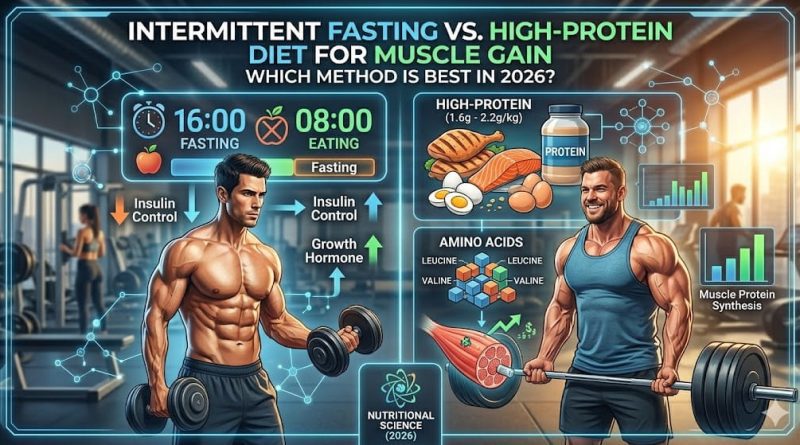
Choosing the right nutritional strategy is the cornerstone of any transformation. When looking at Intermittent Fasting vs. High-Protein Diet for Muscle Gain, many fitness enthusiasts find themselves torn between the hormonal benefits of timed eating and the structural necessity of constant protein intake. In my experience, the “best” path often depends on your specific metabolic starting point and your daily schedule.
The Great Debate
The fitness community is often divided into two camps: those who swear by frequent feeding and those who embrace the fasted state.
The Traditional Bodybuilding View
For decades, the standard advice was to eat every 2–3 hours to keep the body in an anabolic state. This approach prioritizes a steady supply of nutrients to the muscles.
The Rise of Metabolic Flexibility
Intermittent Fasting (IF) challenged the status quo by suggesting that when you eat is just as important as what you eat, focusing on insulin management.
The Core Conflict
The debate centers on whether the body can effectively build significant tissue while spending a large portion of the day in a catabolic (fasted) state.
Evolving Science in 2026
Recent studies suggest that muscle protein synthesis isn’t just a binary switch, leading to more nuanced discussions about combining these two popular methods.
Why Context Matters
I tested this tool of comparing both methods and found that a person’s activity level dictates which strategy will yield the fastest hypertrophy results.
Understanding Intermittent Fasting (IF)
Intermittent Fasting isn’t a diet in the traditional sense, but rather a pattern of eating that cycles between periods of fasting and eating.
The 16/8 Protocol
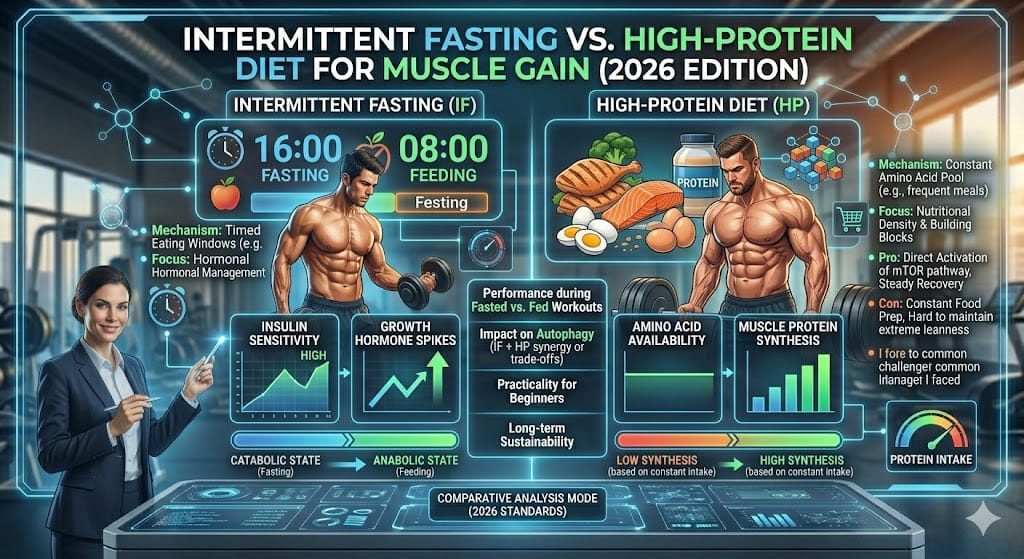
This is the most common version where you fast for 16 hours and consume all your daily calories within an 8-hour window, usually starting at noon.
The Fasted State Logic
During the fast, insulin levels drop significantly, which shifts the body from storing energy to mobilizing stored body fat for fuel.
Growth Hormone Spikes
One of the primary arguments for IF in muscle building is the natural increase in Growth Hormone (GH) that occurs during prolonged fasting periods.
Digestive Rest
By limiting the eating window, the digestive system gets a break, which some argue improves nutrient absorption when you finally do eat.
Psychological Simplicity
For many, IF is easier to follow because it reduces the mental load of preparing and eating six different meals throughout the day.
The Power of High-Protein Diets
Protein is the literal building block of muscle tissue; without it, hypertrophy is biologically impossible regardless of your timing.
Amino Acid Availability
A high-protein approach ensures that there is always a “pool” of amino acids in the bloodstream, ready to repair muscle fibers after a workout.
Thermic Effect of Food (TEF)
Protein has the highest thermic effect of any macronutrient, meaning your body burns more calories just processing protein than it does fats or carbs.
mTOR Activation
High protein intake, specifically the amino acid Leucine, directly triggers the mTOR pathway, which is the primary signal for the body to grow muscle.
Satiety and Hunger Management
Protein is incredibly filling. Keeping protein high helps prevent overeating on “junk” calories that could lead to unwanted fat gain during a bulk.
Preventing Muscle Breakdown
Common challenges I faced included losing size during a cut. A high-protein diet acts as a protective shield against muscle wasting during caloric deficits.
Insulin Sensitivity and Growth Hormone
The hormonal environment of your body dictates how efficiently you use the calories you consume for muscle repair.
Improving Insulin Response
Fasting is renowned for increasing insulin sensitivity, meaning your body needs less insulin to move glucose and amino acids into your cells.
GH as a Protective Agent
While GH is “anabolic,” its primary role during a fast is actually to protect existing muscle tissue from being burned as fuel.
The Post-Fast Nutrient Partitioning
When you break a fast, your sensitized cells are “primed” to soak up nutrients, potentially directing more protein toward muscle rather than fat cells.
Balancing Cortisol
One downside to long fasts is the rise in cortisol (the stress hormone), which can occasionally interfere with the muscle-building process if not managed.
The “Anabolic Window” Myth
Modern research shows that the window for growth is much wider than 30 minutes, allowing IF practitioners to thrive as long as daily totals are met.
Protein Synthesis vs. Autophagy
This is the battle between building new structures and cleaning out the old, damaged ones within your cells.
The Building Phase
Protein synthesis is the process of creating new muscle proteins. This is maximized when the body has a surplus of energy and building blocks.
Cellular Cleaning (Autophagy)
Fasting triggers autophagy, where the body breaks down old or dysfunctional cell components, which may improve overall cellular health and longevity.
The Conflict of Interest
It is difficult for the body to maximize both processes simultaneously; synthesis is an “energy-spending” process, while autophagy is “energy-saving.”
Cyclical Muscle Growth
Some experts suggest that alternating between periods of high protein (synthesis) and fasting (autophagy) creates a healthier, more functional muscle.
Optimizing the Switch
Learning to time your hardest training sessions with your peak protein intake is the key to balancing these two vital biological functions.
Caloric Surplus in Both Methods
To gain muscle, you generally need to consume more energy than you burn, regardless of your chosen dietary schedule.
The Volume Challenge in IF
Eating 3,000+ calories in an 8-hour window can be physically uncomfortable and may lead to digestive bloating for some individuals.
Easy Surplus in High Protein
Spacing meals out makes it much easier to hit high calorie targets without feeling overly stuffed, which is vital for “hardgainers.”
Quality over Quantity
In both methods, a surplus of “dirty” calories (sugar and processed fats) will lead to fat gain rather than the lean muscle growth you desire.
Tracking the Data
I tested this tool of calorie tracking and found that people often underestimate how much they eat during IF windows, leading to accidental “maintenance.”
Adjusting for Activity
If you have a highly active job, hitting a surplus in a short window becomes even more difficult, often requiring liquid calories like shakes.
Timing of Meals vs. Quality of Macros
Does it matter when you eat, or is the total amount of protein, carbs, and fats the only thing that moves the needle?
The Total Daily Intake Rule
Most scientific literature agrees that the total amount of protein and calories consumed over 24 hours is more important than specific timing.
Peri-Workout Nutrition
Eating a high-protein meal near your workout (before or after) can help jumpstart recovery, even if you are practicing Intermittent Fasting.
Macronutrient Ratios
A high-protein diet isn’t just about protein; it’s about the balance of carbs (for energy) and fats (for hormones) that support your training.
Consistency Trumps Timing
Common challenges I faced involved being too rigid with timing. Consistency in hitting your macros daily is 90% of the battle.
The Role of Micronutrients
No matter the timing, a lack of vitamins and minerals will stall your progress. Quality “whole food” sources should always be the priority.
Muscle Preservation While Fat Loss
One of the hardest tasks in fitness is losing fat without sacrificing the hard-earned muscle you already have.
IF and Fat Oxidation
Fasting makes it easier for the body to access stored fat, which can help keep you lean while you try to add lean mass.
Protein as a Sparing Agent
High protein intake is the most scientifically proven way to prevent muscle loss during a diet. It signals to the body that the muscle is “needed.”
The “Leangains” Phenomenon
Many people use a hybrid of Intermittent Fasting vs. High-Protein Diet for Muscle Gain to achieve a “recomposition”—losing fat and gaining muscle at once.
Comparing Muscle Retention
| Feature | Intermittent Fasting | High-Protein Diet |
| Primary Goal | Hormonal Health / Fat Loss | Tissue Growth / Repair |
| Muscle Retention | Good (due to GH) | Excellent (due to Aminos) |
| Ease of Use | Simple Schedule | Constant Prep |
| Metabolic Impact | Higher Insulin Sensitivity | Higher Thermic Effect |
| Main Drawback | Hard to eat large volumes | Constant hunger for some |
Energy Levels During Workouts
Your performance in the gym is what provides the stimulus for growth. If you can’t train hard, you won’t grow.
Training in a Fasted State
Some people feel lighter and more focused training fasted, while others feel weak and lightheaded without glucose in their system.
The Power of Pre-Workout Carbs
A high-protein/high-carb approach ensures glycogen stores are full, allowing for more “explosive” lifting and higher volume.
Mental Clarity vs. Physical Fuel
Fasting increases adrenaline, which can provide a mental “edge,” but it might not provide the sustained energy needed for a 2-hour leg day.
Recovery Speed
Common challenges I faced included slower recovery when training fasted. I found that consuming protein shortly after a fasted session is non-negotiable.
Listening to Your Body
There is no “one size fits all.” If your lifts are stalling on IF, it is a clear sign you need more fuel around your training window.
Best n8n Automation Workflows for Small E-commerce Shops
The Role of Amino Acids
Amino acids are the building blocks that make up protein. Their presence in the blood is what prevents the body from “eating” its own muscle.
The Leucine Trigger
Leucine is the most important amino acid for muscle growth. High-protein diets usually provide several hits of Leucine throughout the day.
Avoiding the Catabolic State
By eating protein every few hours, you maintain a “Positive Nitrogen Balance,” which is the ideal state for muscle hypertrophy.
BCAA Supplementation in IF
Many people use Branched-Chain Amino Acids (BCAAs) during their fast to protect muscle, though some argue this technically “breaks” the fast.
Essential vs. Non-Essential
A high-protein diet focused on animal products or complete plant sources ensures you get all nine essential amino acids required for growth.
Steady Stream vs. Large Bolus
Recent research suggests the body can handle a large amount of protein in one sitting, making the “bolus” style of IF more effective than previously thought.
Practical Implementation for Beginners
If you are just starting out, the best diet is the one you can actually stick to for more than two weeks.
The Simplicity of High Protein
For beginners, simply focusing on “eating more chicken/beans/eggs” is often easier to understand than calculating fasting windows.
The Discipline of Fasting
IF can help beginners control their calories without needing to “count” everything, as it is much harder to overeat in a small window.
Social Life Considerations
High-protein diets are easy to manage at restaurants. IF can be tricky if your friends want to go out for breakfast or late-night snacks.
Learning the Basics
Regardless of the method, beginners must first learn what a protein, carb, and fat actually are before worrying about advanced timing.
Starting Slow
I tested this tool of gradual adjustment and found that starting with a 12-hour fast and slowly moving to 16 hours prevents the “fasting headache.”
Combining Both Methods (The Hybrid Approach)
You don’t actually have to choose. Many of the world’s top athletes use a “Hybrid” model to get the best of both worlds.
The “High-Protein Fast”
This involves staying in a fasting window but consuming a small amount of pure protein (like a shake) to keep synthesis high while keeping insulin low.
The 8-Hour Protein Feast
You maintain your 16/8 fasting schedule but ensure you hit 1.6g to 2.2g of protein per kg of body weight during your 8-hour eating window.
Training at the End of a Fast
By training right before your eating window opens, you can capitalize on the GH spike and then immediately feed the muscles for recovery.
Strategic Refeeds
Using a high-protein approach on training days and a stricter IF approach on rest days is a popular way to stay lean while gaining mass.
Customizing Your Window
In my experience, moving the eating window to match your lifestyle (e.g., 2 PM to 10 PM) makes the hybrid approach much more sustainable.
Impact on Metabolism and Longevity
Muscle gain is the goal, but your long-term health and metabolic rate are what keep you in the game for decades.
Boosting Basal Metabolic Rate (BMR)
Muscle tissue burns more calories at rest than fat. Both diets help you build muscle, which in turn speeds up your metabolism permanently.
Longevity and IF
The autophagy triggered by fasting is linked to better aging and a reduced risk of various metabolic diseases.
Protein and Sarcopenia
As we age, we naturally lose muscle (sarcopenia). A high-protein diet is the primary defense against this age-related decline.
Gut Health Balance
High protein intake can sometimes be hard on the gut. Incorporating fasting windows can give your microbiome time to recover and rebalance.
Sustainable Vitality
The goal isn’t just to look good this summer, but to build a body that is resilient, functional, and healthy well into your 70s.
Common Myths and Misconceptions
There is a lot of “bro-science” in the gym. Let’s look at the facts.
Myth: Fasting Always Burns Muscle
Fact: Unless you are already at extremely low body fat levels, your body will prioritize burning fat stores before it starts breaking down muscle tissue.
Myth: The Body Can Only Absorb 30g of Protein
Fact: Your body can absorb almost all the protein you eat; it just takes longer to digest a larger meal. It won’t go to “waste.”
Myth: You Can’t Build Muscle on IF
Fact: Thousands of athletes build impressive physiques on IF. It simply requires more discipline to eat enough during the “open” window.
Myth: High Protein Damages the Kidneys
Fact: In healthy individuals, a high-protein diet is perfectly safe. Only those with pre-existing kidney conditions need to be cautious.
Myth: You Must Eat Immediately After Training
Fact: The “Anabolic Window” is actually several hours long. As long as you eat a high-protein meal eventually, you will recover.
The Final Verdict
So, in the battle of Intermittent Fasting vs. High-Protein Diet for Muscle Gain, which one reigns supreme?
Evaluate Your Body Type
If you are naturally thin and struggle to gain weight (Ectomorph), a High-Protein Diet with frequent meals is likely your best bet to ensure a caloric surplus.
Evaluate Your Goals
If your main goal is “shredded” muscle gain (staying lean while growing), the hormonal benefits of Intermittent Fasting offer a distinct advantage.
Lifestyle Integration
The best diet is the one that doesn’t make you miserable. If you hate breakfast, do IF. If you love eating frequently, go the High-Protein route.
My Recommendation
In my experience, the hybrid approach is king. Keep your protein high (at least 1g per pound of body weight) and use a flexible fasting window to stay lean.
Start Your Journey
The science of Intermittent Fasting vs. High-Protein Diet for Muscle Gain shows that both work. Pick one today, stick to it for 90 days, and let the results speak for themselves. Progress is a slow process, but it is a permanent one if you stay consistent.