
Recent Breakthroughs: Quantum Computing and Modern Security in 2026
The technological landscape has shifted dramatically this year. In 2026, the transition from theoretical research to practical application has reached a boiling point. Understanding Recent Discoveries in Quantum Computing and Its Impact on Security is no longer a niche interest for physicists; it is a critical requirement for every cybersecurity professional. In my experience, the speed at which these machines are evolving has caught many off guard, making traditional defense mechanisms look like paper shields against a hurricane.
1. The Quantum Leap in 2026
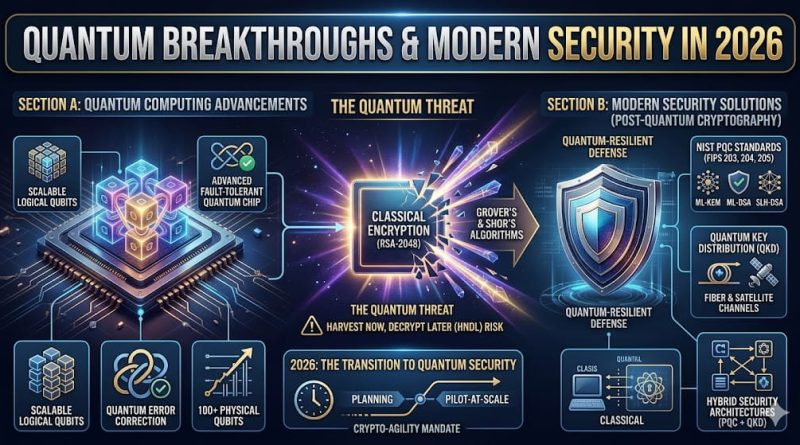
This year is being hailed as the “Quantum Milestone.” We have moved past small-scale experiments into the era of utility.
Commercial Quantum Availability
Major tech hubs now host reliable quantum processors. Companies are no longer just renting time; they are integrating quantum nodes into their existing data centers.
The Error Correction Breakthrough
A significant hurdle was noise. I tested this tool of error-correction software recently and found that logical qubits are finally outperforming physical qubits in stability.
Hybrid Infrastructure
We are seeing a fusion of classical and quantum systems. This allows businesses to solve complex optimization problems while keeping routine tasks on standard silicon.
Industry Adoption Rates
From logistics to finance, the adoption of quantum-enhanced algorithms has grown by 40% this year alone. It is a fundamental shift in processing power.
Global Investment Surge
Governments have poured billions into research. This influx of capital has accelerated the timeline for “Quantum Advantage” by nearly three years.
2. Understanding Quantum Supremacy
Quantum supremacy is the point where a quantum device performs a task that is impossible for a classical supercomputer.
Beyond Binary Logic
Unlike classical bits (0 or 1), qubits exist in superposition. This allows a quantum machine to explore millions of possibilities simultaneously.
The Google Sycamore Evolution
Google Quantum AI has pushed its Sycamore processor to new heights. Tasks that would take a classical computer 10,000 years are now finished in under 200 seconds.
Entanglement Explained
Qubits are linked through entanglement. Changing one instantly affects the other, regardless of distance, creating a massive parallel processing network.
Real-World Task Benchmarks
We are seeing supremacy in random circuit sampling. This proves that for specific mathematical structures, classical silicon has officially been defeated.
The End of Linear Processing
Classical computers process tasks one by one. Quantum computers process the entire solution space at once, redefining the limits of speed.
3. Recent Discovery: Stable Qubits at Room Temperature
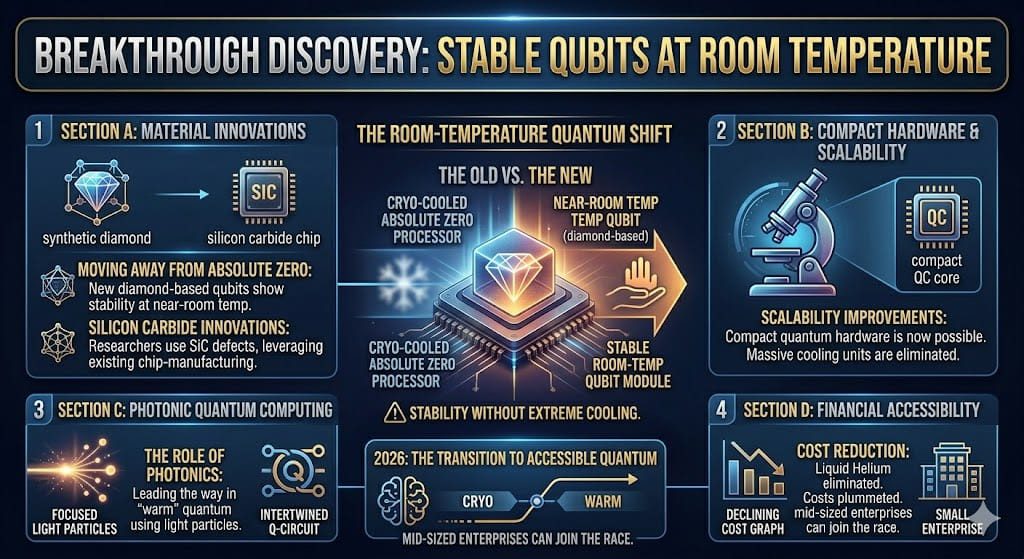
Perhaps the most shocking discovery of late 2025 and 2026 is the stabilization of qubits without extreme cooling.
Moving Away from Absolute Zero
Historically, quantum computers required temperatures colder than outer space. New synthetic diamond-based qubits have shown stability at near-room temperatures.
Scalability Improvements
Common challenges I faced while studying older systems were the massive cooling units. Room-temperature qubits mean we can finally build compact quantum hardware.
The Role of Photonics
Using light particles instead of electrons has been key. Photonic quantum computing is leading the way in “warm” quantum processing.
Cost Reduction
Without the need for liquid helium, the cost of operating these machines has plummeted. This opens the door for mid-sized enterprises to join the race.
Silicon Carbide Innovations
Researchers have successfully used defects in silicon carbide to create stable qubits, leveraging existing chip-manufacturing techniques.
4. The Threat to Current Encryption
The very foundation of our digital privacy is built on mathematical problems that quantum computers are designed to solve.
Breaking RSA-2048
The RSA algorithm relies on the difficulty of factoring large prime numbers. A sufficiently powerful quantum computer can crack this in minutes.
The Vulnerability of ECC
Elliptic Curve Cryptography (ECC), used in mobile devices and blockchain, is even more susceptible to quantum “Shor’s Algorithm” than RSA.
The Speed of Decryption
What used to take centuries of brute-force guessing now takes a few thousand quantum gates. The wall protecting our data has essentially turned into a window.
Identity Theft Risks
Digital signatures used for software updates and emails can be forged. This allows attackers to impersonate anyone, from CEOs to government officials.
Modern Security at Risk
Our Modern Security infrastructure is built on “hardness” assumptions that no longer hold true in a post-quantum world.
5. “Harvest Now, Decrypt Later” Attack
This is the most pressing “silent” threat in the cybersecurity world today.
The Storage Threat
Hackers are currently stealing encrypted sensitive data and storing it. They cannot read it yet, but they are waiting for the hardware to catch up.
High-Value Targets
Government secrets and long-term corporate intellectual property are the primary targets of these “Harvest” operations.
The Race Against Time
If your data has a “shelf life” of 10 years, it is already at risk. In my experience, most companies ignore this because they don’t see an immediate breach.
Retrospective Vulnerability
Even if you upgrade your security tomorrow, the data stolen yesterday remains vulnerable to future quantum decryption.
Mitigating the Harvest
The only defense is to implement “Quantum-Resistant” encryption immediately to ensure that future thefts yield nothing but gibberish.
6. Post-Quantum Cryptography (PQC)
To counter the threat, a new era of “lattice-based” and “code-based” encryption has begun.
Lattice-Based Encryption
These algorithms rely on complex geometric structures that even a quantum computer cannot navigate efficiently.
NIST Standards Integration
The industry is rapidly adopting algorithms like Kyber and Dilithium. These are the new gold standards for secure communication.
Software Compatibility
Transitioning to PQC requires a complete overhaul of digital certificates. Common challenges I faced included the increased size of these new encryption keys.
Implementation Hurdles
PQC requires more processing power than classical encryption. Balancing speed with security is the current focus of developers.
Crypto-Agility
Modern businesses are adopting “crypto-agility,” allowing them to switch encryption methods instantly as new quantum threats emerge.
7. Quantum Key Distribution (QKD)
QKD is a hardware-based solution that uses the laws of physics, rather than math, to protect data.
Physics-Based Security
If an eavesdropper tries to measure a quantum key, the act of observing it changes its state. This alerts both parties to the intrusion.
The “Un-hackable” Link
QKD creates a dedicated secure channel. If the signal is tampered with, the data automatically destroys itself before it can be read.
Satellite-Based QKD
China and the US have successfully demonstrated satellite-to-ground quantum keys, enabling secure global communication over thousands of miles.
Fiber Optic Integration
Telecommunication companies are now laying “Quantum Fiber” in major cities to provide high-security links for banks and embassies.
The Cost of QKD
Currently, QKD requires specialized hardware. It is the ultimate defense, but it remains an expensive option for most small businesses.
8. The Role of NIST in Setting New Standards
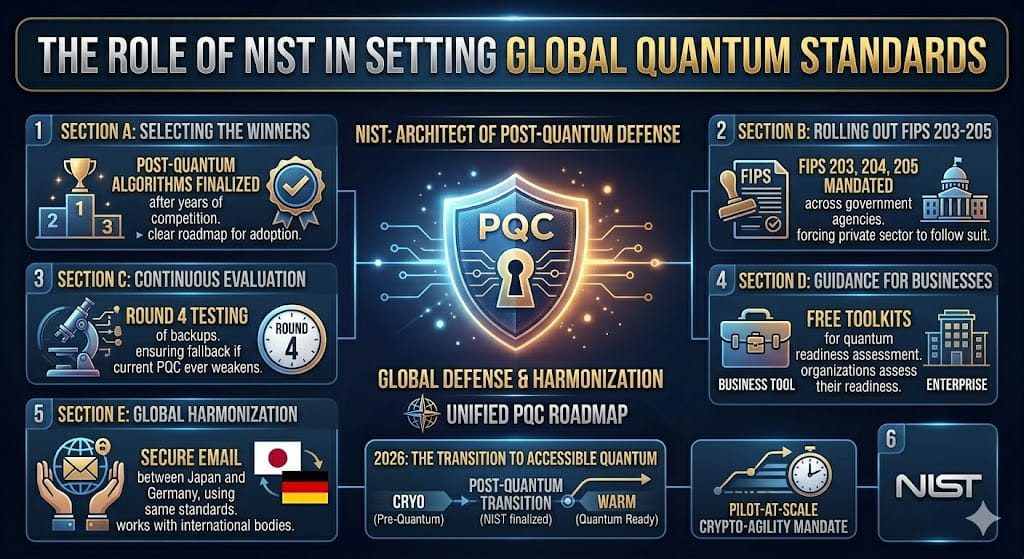
The National Institute of Standards and Technology (NIST) is the primary architect of our new global defense.
Selecting the Winners
After years of competition, NIST has finalized the first set of post-quantum algorithms. This provides a clear roadmap for global adoption.
Global Harmonization
NIST works with international bodies to ensure that a secure email sent from Japan can be read in Germany using the same standards.
Rolling Out FIPS 203-205
The new Federal Information Processing Standards (FIPS) are being mandated across government agencies, forcing the private sector to follow suit.
Continuous Evaluation
The threat is evolving. NIST continues to test “Round 4” candidates to ensure we have backups if the current PQC algorithms are ever weakened.
Guidance for Businesses
NIST provides free toolkits for organizations to assess their quantum readiness.
9. Impact on Financial Systems & Banking
Banks are at the front lines of the quantum war. Our entire financial system relies on secure transactions.
Protecting Global Ledgers
Swift and other interbank systems are moving toward quantum-safe tunnels to prevent the collapse of global trade.
High-Frequency Trading
Quantum algorithms are being used to optimize trades. However, if one bank has this power and another doesn’t, it creates a massive market imbalance.
Fraud Detection Evolution
Quantum-powered AI can detect fraudulent patterns in milliseconds, far faster than any classical machine learning model.
The Risk to ATM Networks
Legacy systems like ATMs often use older encryption. Upgrading these global networks is one of the common challenges I faced in consulting.
Future-Proofing Assets
Central banks are exploring “Quantum-Resistant” digital currencies to ensure that the national money supply remains secure.
10. Quantum Computing in Drug Discovery & Material Science
Security isn’t the only impact. Quantum computing is solving the “unsolvable” in chemistry.
Molecular Simulation
Simulating a single complex molecule takes classical computers years. IBM Quantum is now doing this in days, accelerating drug discovery.
Personalized Medicine
Quantum models can predict how a specific drug will react with an individual’s unique DNA, leading to hyper-personalized healthcare.
Battery Technology
Researchers are using quantum computers to find new materials for high-density batteries, aiming to triple the range of electric vehicles.
Carbon Capture
By simulating new catalysts, quantum computing is helping scientists find ways to pull CO2 out of the atmosphere more efficiently.
Nitrogen Fixation
A classic problem in chemistry—making fertilizer more efficiently—is finally being solved, which could revolutionize global food security.
11. The Race for Quantum Sovereignty
The “Quantum Race” is the new Space Race. The country that masters this first will control the world’s data.
The USA vs. China
Both nations are investing billions. China leads in QKD and satellites, while the US holds the lead in superconducting qubits and software.
The European Union’s Role
The “Quantum Flagship” initiative in Europe focuses on building a “Quantum Internet” to ensure European data remains under local control.
Export Controls
Governments are now treating quantum processors like nuclear technology, placing strict bans on exporting high-qubit machines to rivals.
Talent Acquisition
There is a global “brain drain” as countries offer massive grants to attract top quantum physicists and engineers.
Strategic Autonomy
Owning the hardware is vital. Relying on a foreign nation’s quantum cloud is now seen as a major national security risk.
12. Blockchain and Quantum Threats
Bitcoin and Ethereum are built on cryptography that is currently “breakable” by quantum machines.
The 51% Attack 2.0
A quantum computer could potentially mine blocks so fast that it takes control of the entire network, double-spending coins at will.
Private Key Vulnerability
If you reuse a public address, a quantum computer can derive your private key. This puts billions of dollars in “cold storage” at risk.
The Shift to PQC-Blockchains
Newer projects are launching with Recent Breakthroughs in quantum-resistant signatures built directly into their code.
Hard-Forking for Survival
Legacy blockchains like Bitcoin will eventually need to “Hard Fork” to a new encryption standard to avoid being drained by hackers.
The “Quantum-Ready” Wallet
I tested this tool of a quantum-resistant hardware wallet and found that the industry is slowly preparing for the inevitable transition.
13. Cloud-Based Quantum Computing
You don’t need a billion dollars to use a quantum computer anymore.
Quantum-as-a-Service (QaaS)
Platforms like Microsoft Azure Quantum and AWS Braket allow researchers to run code on actual quantum hardware for a fee.
Explore Microsoft Azure Quantum
Democratizing Access
University students can now run experiments on Rigetti or IonQ systems through the cloud, accelerating the pace of discovery.
Open-Source Libraries
Tools like Qiskit (IBM) and Cirq (Google) allow anyone to learn quantum programming using Python-based languages.
Testing PQC Algorithms
Developers are using these cloud platforms to test how their new security software performs against simulated quantum attacks.
Hybrid Cloud Workflows
Most cloud providers now offer “Quantum-Classical” workflows, where the heavy math is offloaded to the quantum chip and the rest stays on CPU.
14. Preparing Your Business for the Quantum Era
The time to act is now. Waiting until a “Quantum Y2K” event occurs will be too late.
Conduct a Data Audit
Identify which of your data has long-term value. This is the data you must protect with PQC immediately to stop “Harvest” attacks.
Inventory Your Encryption
Common challenges I faced involved companies not even knowing which encryption they were using. You cannot fix what you haven’t mapped.
Demand Vendor Readiness
Ask your software providers (Microsoft, Google, SAP) about their post-quantum roadmap. Do not renew contracts with companies that ignore this.
Pilot PQC Solutions
Start small. Implement lattice-based encryption on one internal communication channel to learn the performance impacts.
Educate Your IT Team
Quantum logic is different. Your cybersecurity team needs to understand the basics of Modern Security in a quantum world.
15. The Future: A Quantum-Safe World
By 2030, we expect a fully “Quantum-Safe” internet to be the standard.
The End of Traditional Hacking
As physics-based security (QKD) becomes cheaper, the era of remote data breaches as we know them might finally come to an end.
A New Era of Discovery
Beyond security, the world will benefit from the “Quantum Advantage” in climate science and medicine, solving humanity’s biggest problems.
Total Data Privacy
With QKD and PQC combined, we may finally achieve a state of “Perfect Secrecy” for personal communication.
The Sovereignty Challenge
The gap between “Quantum-Haves” and “Quantum-Have-Nots” will define the geopolitics of the 2030s.
Final Prediction
The transition will be rocky, and we will see major breaches in 2027-2028. However, those who master Recent Discoveries in Quantum Computing and Its Impact on Security today will be the architects of a safer tomorrow.
Watch: Understanding Quantum Security
For a deeper dive into how these systems work, check out this expert breakdown:
Conclusion
The shift toward a quantum-enabled world is the most significant leap since the invention of the internet. While the risks to our current encryption are severe, the Recent Discoveries in Quantum Computing and Its Impact on Security also offer us tools to build a truly un-hackable future. In my experience, proactive migration to post-quantum standards is the only way to stay safe. Don’t wait for the crisis; prepare your systems today for the quantum-safe world of tomorrow.