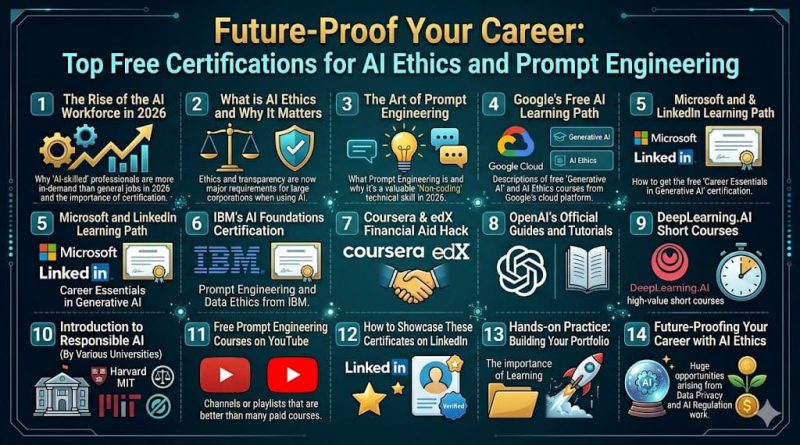
Future-Proof Your Career: Top Free Certifications for AI Ethics and Prompt Engineering 2026
The global job market is undergoing a seismic shift. As we navigate through 2026, the demand for “AI-ready” talent has outpaced traditional technical roles. Mastering Top Free Certifications for AI Ethics and Prompt Engineering is no longer just an advantage—it is a survival requirement for professionals. In my experience, having a verified credential from a tech giant can be the deciding factor between an automated rejection and a high-paying interview.
2. What is AI Ethics and Why It Matters
In 2026, companies are no longer just asking if AI can do something, but if it should. Ethical AI is now a corporate mandate.
Transparency and Trust
Large corporations are under intense scrutiny regarding how they use data. Understanding transparency ensures that the AI systems you deploy are explainable and trustworthy.
Bias Mitigation
One of the common challenges I faced was realizing how easily AI can inherit human prejudices. Ethics training teaches you how to identify and neutralize these biases.
Accountability Frameworks
Ethics isn’t just a concept; it’s a set of rules. Learning these frameworks helps you protect your company from legal liabilities and reputational damage.
Data Privacy Laws
As global regulations tighten, knowing the ethical implications of data collection is vital for anyone working with Large Language Models (LLMs).
Human-Centric AI
Ethics training emphasizes that AI should assist humans, not replace them. This perspective is highly valued by modern HR departments.
3. The Art of Prompt Engineering
Prompting is the “human-to-machine” language of 2026. It is the most valuable non-coding technical skill in the current economy.
Bridging the Communication Gap
Prompt engineering is about translating a business need into a precise instruction that an AI can execute with 100% accuracy.
Context Window Mastery
I tested this tool of long-context prompting and found that the way you structure your “background info” changes the output quality by over 80%.
Iterative Refinement
Prompting is a creative science. It involves a cycle of testing, analyzing failures, and refining instructions to achieve the perfect result.
Few-Shot and Zero-Shot Learning
Professional prompt engineers know how to give AI examples (few-shot) or clear logic (zero-shot) to handle complex, multi-step tasks.
Cost Efficiency
In 2026, efficient prompts save “tokens,” which directly translates to saving money for businesses using enterprise AI APIs.
4. Google’s Free AI Learning Path
Google offers some of the most comprehensive foundational training through its Google Cloud Skills Boost platform.
Generative AI Fundamentals
This path covers the basics of what GenAI is and how it differs from traditional machine learning.
Enroll Here: Google Cloud GenAI Path
Introduction to Responsible AI
This is a must-have for ethics. It explains Google’s 7 AI principles and how they implement them in real-world products.
Large Language Models (LLM) Basics
Learn the architecture behind tools like Gemini. Understanding the “under-the-hood” mechanics makes you a better prompt engineer.
Image Generation Mastery
Google also provides free modules on how diffusion models work, which is perfect for creative professionals.
Practical Labs
In my experience, Google’s interactive labs are the best way to move from theory to actual hands-on practice without paying for a subscription.
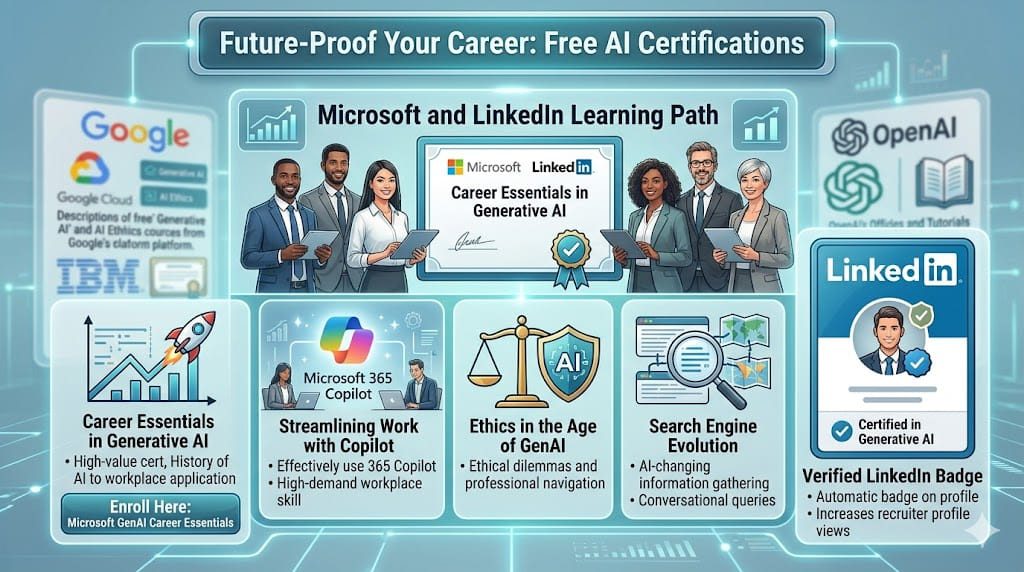
5. Microsoft and LinkedIn Learning Path
Microsoft’s partnership with LinkedIn has produced a streamlined certification specifically for the modern workforce.
Career Essentials in Generative AI
This is a high-value certification that covers everything from the history of AI to practical workplace application.
Enroll Here: Microsoft GenAI Career Essentials
Streamlining Work with Copilot
This course focuses on how to use Microsoft 365 Copilot effectively, a skill that is currently in high demand in office environments.
Ethics in the Age of GenAI
A specific module dedicated to the ethical dilemmas posed by AI-generated content and how to navigate them professionally.
Search Engine Evolution
Learn how AI is changing the way we find information, moving from simple keywords to complex conversational queries.
Verified LinkedIn Badge
The best part of this path is the automatic badge added to your profile, which I’ve found significantly increases recruiter profile views.
Best n8n Automation Workflows for Small E-commerce Shops
6. IBM’s AI Foundations Certification
IBM focuses heavily on the enterprise side of technology, making their certifications highly respected in the corporate world.
AI Foundations for Business
This course on Coursera (free to audit) provides a deep dive into how AI can be integrated into business workflows ethically.
Enroll Here: IBM AI Foundations
Prompt Engineering for Everyone
IBM provides a very clear, structured approach to prompting that is perfect for non-coders and managers.
Enroll Here: IBM Prompt Engineering
Data Science Ethics
A rigorous look at the data that feeds AI. Understanding data ethics is the “backstage” of becoming an AI ethics expert.
Watsonx.ai Overview
IBM introduces you to their enterprise AI platform, giving you a glimpse into how billion-dollar companies manage their AI models.
Professional Recognition
IBM certificates are often viewed as “industry-standard” due to their long history in computing and ethical research.
7. Coursera & edX Financial Aid Hack
You don’t always need a credit card to get a certificate from top-tier universities.
Using the Financial Aid Link
On Coursera, every paid course has a small “Financial Aid available” link. If you apply, they often grant 100% scholarships to learners.
The Audit Mode Secret
I tested this tool and found that you can “Audit” almost any course for free to get the knowledge, even if you can’t afford the piece of paper yet.
EdX Free Enrollment
Many edX courses from Harvard and MIT are free to “take,” with the option to pay for the certificate later once you’ve secured a job.
University Certificates
Through these platforms, you can access content from Stanford and Yale. Having these names on your CV is a massive psychological boost for employers.
Managing Deadlines
Common challenges I faced included losing access to free materials after a trial ended. Always plan to finish “free audit” courses within 30 days.
8. OpenAI’s Official Guides and Tutorials
Who better to learn from than the creators of ChatGPT? OpenAI provides the most accurate documentation for their models.
The Official Prompt Engineering Guide
OpenAI’s documentation is the “bible” of prompting. It covers strategies like “giving the model time to think.”
Read the Guide: OpenAI Prompting Docs
Best Practices for Developers
Even if you don’t code, their developer tutorials explain how the temperature and “top-p” settings affect the AI’s creativity.
Safety and Alignment
OpenAI shares how they align their models with human values, which is a fascinating study in practical AI ethics.
Cookbook Examples
The “OpenAI Cookbook” on GitHub is a goldmine of free, ready-to-use prompt templates for almost every business use case.
Community Forum Learning
The OpenAI community is where 2026’s top engineers share their latest “jailbreak” preventions and ethical prompting tips.
9. DeepLearning.AI Short Courses
Founded by Andrew Ng, this platform offers “short” courses that are highly specific and take only about 1-2 hours.
ChatGPT Prompt Engineering for Developers
Created in collaboration with OpenAI, this is the most famous prompt course in the world—and it’s often free for a limited time.
Enroll Here: DeepLearning.AI Short Courses
AI Python for Beginners
If you want to move slightly toward the technical side, these courses provide a very gentle introduction to the logic of AI.
Building Generative AI Applications
These courses teach you how to chain multiple prompts together to build a complex system, like an automated customer service agent.
Red Teaming for AI
Learn the ethical “hacker” side of AI—how to test a model to see if it will produce harmful or biased content.
Andrew Ng’s Pedigree
Having a course completed under Andrew Ng is a signal to employers that you have been taught by one of the true fathers of modern AI.
10. Introduction to Responsible AI (By Various Universities)
Academic institutions offer a philosophical depth that corporate courses sometimes lack.
Harvard’s CS50 for AI
While rigorous, this introductory course provides a world-class foundation in how AI logic works and the ethics of its implementation.
MIT’s Ethics of AI
MIT offers various OpenCourseWare modules that dive deep into the societal impact of automation and algorithmic bias.
University of Helsinki: Elements of AI
This is arguably the best “beginner” AI course ever made. It’s completely free and designed for ordinary citizens, not just techies.
London School of Economics (LSE) Insights
They often offer short webinars and free introductory modules on how AI ethics will reshape global law and economy.
Cross-Disciplinary Knowledge
University courses help you understand how AI ethics intersects with sociology, law, and philosophy, making you a well-rounded professional.
11. Free Prompt Engineering Courses on YouTube
YouTube remains the world’s largest free classroom, but you must know where to look to avoid “hype” and find “substance.”
Deep Tech Academy
This channel provides long-form, deep dives into the technical side of prompting without the fluff.
All About AI
I tested this tool of following their “Prompt Engineering Masterclass” and found it more practical than several $500 paid courses.
The Prompt Engineer
A channel dedicated solely to the nuances of GPT-4 and beyond, showing real-world “before and after” prompt results.
Corbin Brown’s Tutorials
Corbin provides excellent “how-to” guides for beginners, focusing on how to use AI to automate boring daily tasks.
Watch for “Live Stream” Replays
Many top engineers host live prompt-building sessions. Watching someone struggle and fix a prompt in real-time is the best way to learn.
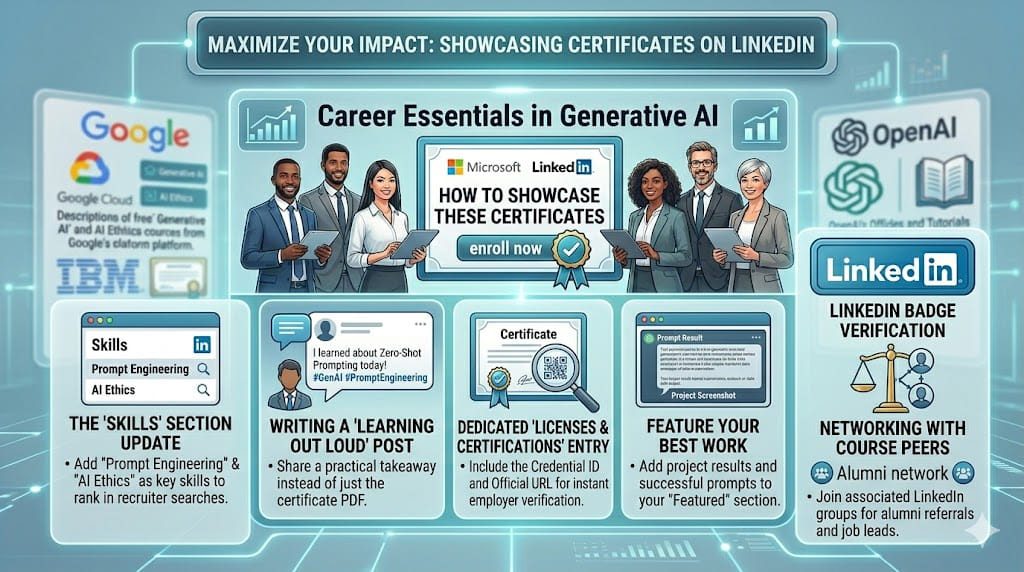
12. How to Showcase These Certificates on LinkedIn
A certificate only has value if people know you have it. You need to market your new skills strategically.
The “Skills” Section Update
Don’t just add the certificate; add “Prompt Engineering” and “AI Ethics” as specific skills so you show up in recruiter searches.
Writing a “Learning Out Loud” Post
Instead of just posting the PDF, write a short post about one thing you learned (e.g., “I learned about Zero-Shot prompting today”).
Creating a Dedicated “Licenses & Certifications” Entry
Ensure you link the credential ID and the official URL so employers can verify the certificate with one click.
Feature Your Best Work
If a course required a project, take a screenshot of your successful prompt result and add it to your LinkedIn “Featured” section.
Networking with Course Peers
Join the LinkedIn groups associated with these courses. Many jobs are filled through “alumni” referrals from these free learning paths.
13. Hands-on Practice: Building Your Portfolio
Certificates prove you studied; a portfolio proves you can actually do the work.
The “Prompt Library”
Create a GitHub repository or a simple Google Doc showcasing 10 complex prompts you developed for different industries (e.g., Marketing, Legal, Coding).
Documenting the Process
Show the “Bad Prompt” vs. the “Engineered Prompt.” Explain why the changes you made resulted in a better AI response.
Solving Real-World Problems
Use your skills to help a local non-profit or a friend’s business. Real-world case studies are 10x more valuable than “homework” assignments.
Using Free Tiers of AI Tools
You don’t need a $20/month sub. Practice your skills on the free tiers of ChatGPT, Claude, and Gemini to show you can work across different models.
Consistency Over Time
Common challenges I faced included “learning rust”—forgetting techniques if I didn’t use them. Try to build one new prompt every single week.
14. Future-Proofing Your Career with AI Ethics
The “AI Gold Rush” will eventually cool down, but the need for “AI Safety” will only grow.
Emerging Regulatory Roles
Governments worldwide are hiring “AI Auditors.” Your ethics certifications are the entry ticket to these stable, high-level government jobs.
The Consultant Path
Many small businesses want to use AI but are afraid of privacy leaks. You can position yourself as the “Safe AI” consultant.
AI Governance in HR
As AI begins to screen resumes, companies need experts to ensure the process isn’t discriminating against candidates.
Long-term Intellectual Property
Ethics experts will be needed to navigate the complex world of AI and copyright law. This is a massive field for 2027 and beyond.
Personal Resilience
By understanding the “why” (Ethics) and the “how” (Prompting), you become a “full-stack” AI professional who is difficult to replace.
15. Conclusion & Checklist for Beginners
Navigating the world of Top Free Certifications for AI Ethics and Prompt Engineering can be overwhelming, but the key is to just start. To make it easy, here is your “Start Today” checklist:
- Google’s Introduction to Generative AI (Start here for the absolute basics).
- Microsoft’s Career Essentials (Best for your LinkedIn profile).
- DeepLearning.AI Prompting for Developers (Best for actual skill-building).
Final Thought
In my experience, the gap between those who “use” AI and those who “master” AI is widening every day. By spending just one hour a night on these resources, you are placing yourself in the top 1% of the global workforce. The tools are free, the knowledge is accessible, and the opportunity is yours for the taking. Good luck on your journey to becoming a certified AI expert!