
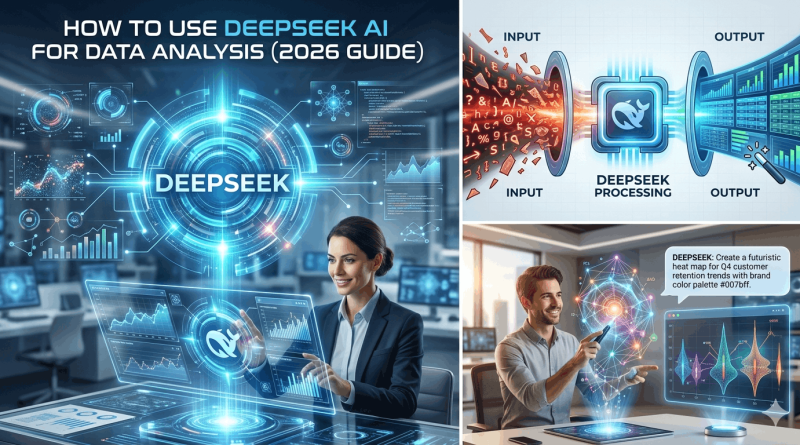
How to Use DeepSeek AI for Data Analysis 2026
Introduction to DeepSeek AI in 2026
DeepSeek has evolved into a powerhouse in the artificial intelligence landscape, specifically tailored for high-compute tasks. By 2026, it has solidified its position as a go-to tool for researchers and analysts worldwide.
Understanding the DeepSeek Architecture
Unlike general-purpose models, DeepSeek utilizes a Mixture-of-Experts (MoE) architecture that optimizes computational efficiency for mathematical and logical reasoning. This makes it exceptionally fast at processing structured data compared to its predecessors.
Why 2026 is the Year of DeepSeek
The 2026 version of DeepSeek introduces native support for multi-modal data streams, allowing it to analyze not just spreadsheets, but also visual charts and live sensor data simultaneously.
DeepSeek vs. General LLMs
While many AI models focus on creative writing, DeepSeek’s training data heavily prioritizes scientific papers and technical documentation, providing it with a deeper “understanding” of statistical significance and numerical precision.
The Role of Open-Source Innovation
DeepSeek continues to lead with an open-weights philosophy, allowing organizations to host models locally. This ensures that the AI’s logic is transparent and customizable for specific industry needs.
Efficiency and Speed at Scale
In the current landscape, DeepSeek’s ability to process massive context windows means you can upload entire databases without the model “forgetting” the initial parameters of your analysis.
Key Features for Data Analysts
DeepSeek isn’t just a chatbot; it is a specialized engine designed to handle the heavy lifting of data science.
Native Code Interpreter 2.0
The 2026 environment features an integrated sandbox where DeepSeek executes Python or R code in real-time, validating the results before presenting them to the user.
Statistical Reasoning Engine
DeepSeek includes a dedicated layer for statistical validation, helping analysts identify p-values, confidence intervals, and potential biases in their datasets automatically.
Multi-Format File Support
Whether you are working with Parquet, SQL dumps, or JSON, DeepSeek’s ingestion engine can parse complex nested structures without manual pre-processing.
Advanced Formula Generation
From complex Excel macros to Google Sheets scripts, the model provides error-free syntax for traditional spreadsheet software, bridging the gap between manual and automated analysis.
Real-time Collaboration Tools
The 2026 interface allows multiple analysts to work on the same DeepSeek “thread,” maintaining a synchronized state of the data cleaning and visualization process.
Setting Up DeepSeek for Your Workflow
Getting started with DeepSeek in 2026 is streamlined, whether you are a solo freelancer or part of a global enterprise.
Accessing the DeepSeek Web Interface
The most direct way to start is through the professional web portal, which offers a drag-and-drop environment for data files and a dedicated “Analysis Mode.”
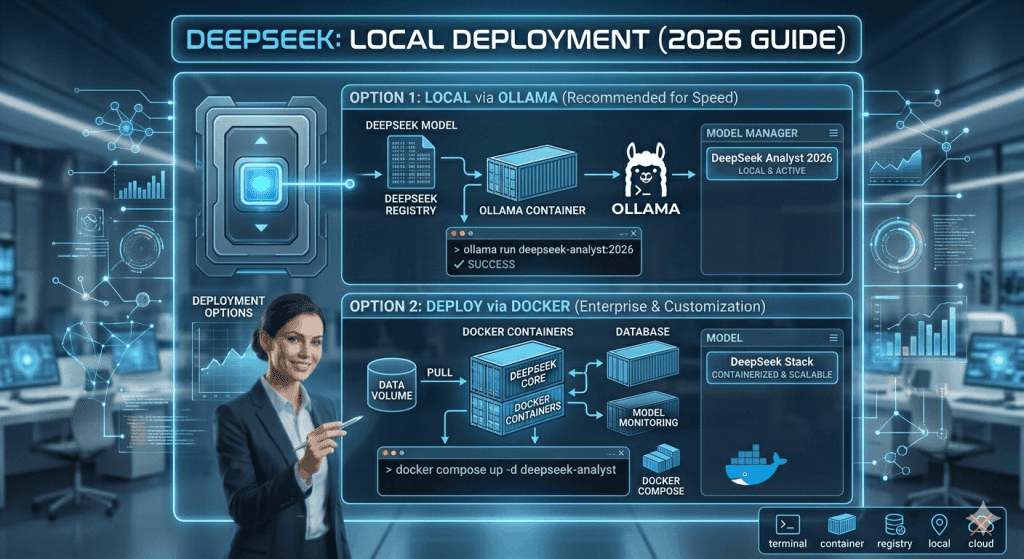
Local Installation via Ollama or Docker
For those prioritizing privacy, DeepSeek can be deployed locally. Using containerized environments like Docker ensures that your data never leaves your internal hardware.
API Key Management
Developers can generate API keys through the DeepSeek Cloud Console. These keys allow for the integration of DeepSeek’s reasoning capabilities into custom software stacks.
Integrating with VS Code and IDEs
DeepSeek offers robust extensions for popular code editors. This allows data scientists to receive AI-powered suggestions directly within their Jupyter Notebooks or Python scripts.
Environment Configuration
Proper setup involves defining “System Prompts” that instruct DeepSeek on your specific industry standards, ensuring the output aligns with your corporate reporting style.
Automating Data Cleaning with DeepSeek
Data cleaning often takes up 80% of an analyst’s time. DeepSeek reduces this drastically through intelligent automation.
Identifying Missing Values
DeepSeek can scan millions of rows to find null values and suggest the best imputation method (mean, median, or mode) based on the distribution of the data.
Standardizing Categorical Data
The AI can automatically detect that “USA,” “U.S.A.,” and “United States” refer to the same entity, cleaning up messy categorical columns in seconds.
Outlier Detection Logic
Using advanced clustering algorithms, DeepSeek flags data points that deviate significantly from the norm and asks the user whether to exclude or investigate them.
Date and Time Normalization
DeepSeek handles the nightmare of conflicting date formats (e.g., DD/MM vs MM/DD) by converting all entries into a unified ISO-standard format.
Automated Deduplication
By analyzing the semantic meaning of rows, DeepSeek identifies “hidden” duplicates that simple exact-match filters might miss.
Writing Complex SQL Queries via DeepSeek
Bridge the gap between natural language and database management with DeepSeek’s SQL capabilities.
Natural Language to SQL Translation
You can simply ask, “Show me the top 10 customers by revenue in Q3,” and DeepSeek will generate the exact JOIN statements and aggregations required.
Optimizing Slow Queries
DeepSeek analyzes existing SQL code to identify bottlenecks, suggesting indexes or query restructuring to improve execution speed.
Schema Understanding
By providing DeepSeek with your database schema, it learns the relationships between tables, ensuring that the generated foreign key joins are accurate.
Handling Multi-Database Dialects
Whether you use PostgreSQL, MySQL, or BigQuery, DeepSeek adjusts its syntax to match the specific requirements of your database engine.
Automated Documentation
DeepSeek can take a wall of complex SQL code and generate a human-readable summary of what the query does, making it easier for team reviews.
Python and R Integration
For advanced data science, DeepSeek acts as a co-pilot for the most popular programming languages in the field.
Pandas and Tidyverse Mastery
DeepSeek generates highly optimized code for data manipulation, utilizing the latest functions in Python’s Pandas or R’s Tidyverse.
Debugging Tracebacks
When your code fails, you can paste the error message into DeepSeek. It not only fixes the code but explains why the error occurred.
Library Recommendations
In 2026, the AI suggests the most modern libraries for specific tasks, such as Polars for fast dataframes or Scikit-learn for modeling.
Automating Repetitive Scripts
Analysts can use DeepSeek to write “wrapper” functions that automate the weekly generation of reports, saving hours of manual coding.
Converting Code Between Languages
DeepSeek can seamlessly translate a data analysis script written in R into Python, or vice-versa, maintaining the logic and output consistency.
Exploratory Data Analysis (EDA) Techniques
DeepSeek excels at finding the “story” within your data during the initial exploration phase.
Generating Summary Statistics
With a single prompt, DeepSeek provides a comprehensive breakdown of means, variances, and distributions across your entire dataset.
Correlation Mapping
The AI identifies hidden relationships between variables, highlighting which factors are most likely influencing your target KPIs.
Hypothesis Testing
DeepSeek can suggest and perform statistical tests (like T-tests or ANOVA) to determine if the patterns seen in the data are statistically significant.
Automated Profiling Reports
By utilizing DeepSeek, you can generate an entire EDA report—complete with observations and potential red flags—in a fraction of the usual time.
Trend Identification
DeepSeek’s time-series awareness allows it to spot seasonality and cyclical trends that might not be obvious in a raw data table.
Advanced Data Visualization Prompts
Transform numbers into narratives with DeepSeek’s visualization expertise.
Suggesting the Right Chart Type
DeepSeek analyzes the nature of your data to recommend whether a heat map, scatter plot, or violin plot is best suited for the message you want to convey.
Matplotlib and Seaborn Code Generation
For Python users, DeepSeek writes complete code blocks to generate publication-quality visuals, including custom labels, colors, and themes.
Interactive Dashboarding with Plotly
DeepSeek can help you build interactive charts that allow users to hover, zoom, and filter data directly within a web browser.
Aesthetic Customization
You can prompt DeepSeek to “Make this chart match my brand colors” or “Use a minimalist style,” and it will adjust the styling parameters accordingly.
Narrative Annotations
Beyond just drawing the graph, DeepSeek can write “callouts” that point to specific peaks or anomalies, explaining their significance to stakeholders.
Analyzing Large Datasets (Big Data)
In 2026, DeepSeek’s ability to handle “Big Data” sets it apart from traditional AI tools.
Chunking and Streaming Data
For files that exceed RAM limits, DeepSeek provides strategies and code for “chunking”—processing data in smaller, manageable segments.
Integration with Spark and Dask
DeepSeek is proficient in writing distributed computing code, allowing analysts to leverage clusters for processing terabytes of information.
Efficient Memory Management
The AI provides tips on data types (e.g., using float32 instead of float64) to reduce the memory footprint of large datasets.
Model Context Windows in 2026
With the 2026 updates, DeepSeek can “remember” the context of massive documents, making it easier to query large-scale qualitative data.
Identifying Scalability Bottlenecks
DeepSeek can analyze your workflow and pinpoint where your data pipeline might break as your data volume grows.
Predictive Analytics and Forecasting
Move from describing the past to predicting the future with DeepSeek’s machine learning capabilities.
Time-Series Forecasting
DeepSeek can implement models like Prophet or ARIMA to help businesses predict future sales, inventory needs, or market trends.
Feature Engineering Suggestions
The AI suggests new variables to create from your existing data (e.g., “Days since last purchase”) to improve the accuracy of your models.
Machine Learning Model Selection
Based on your goals, DeepSeek recommends whether to use Random Forests, XGBoost, or Neural Networks for your specific prediction task.
Model Evaluation Metrics
DeepSeek doesn’t just build models; it explains Accuracy, Precision, Recall, and F1-scores to ensure you understand how reliable your predictions are.
Simulating “What-If” Scenarios
Using predictive logic, DeepSeek can simulate how changes in one variable (like price) might impact another (like demand).
DeepSeek vs. ChatGPT for Data Science
A neutral look at how DeepSeek compares to OpenAI’s flagship model in the realm of analytics.
Computational Accuracy
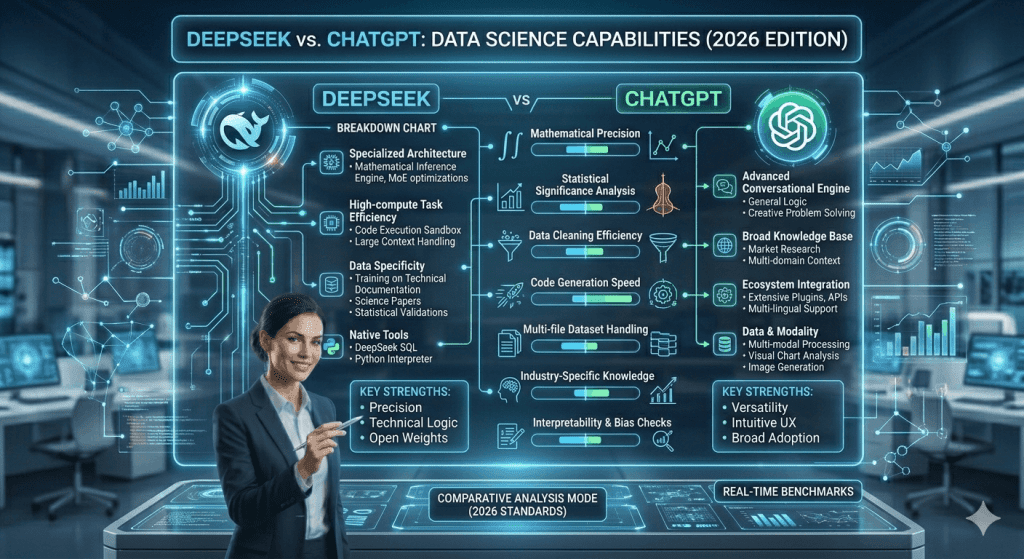
While ChatGPT is superior at conversational nuances, DeepSeek often shows higher accuracy in raw mathematical computations and code logic.
Cost-Efficiency for Developers
In 2026, DeepSeek’s API remains significantly more affordable for high-volume data processing compared to the GPT-4 or GPT-5 equivalents.
Specialized vs. General Intelligence
ChatGPT is a “Jack of all trades,” whereas DeepSeek is often perceived as a “Specialist” for STEM (Science, Technology, Engineering, Mathematics) fields.
Integration Ecosystem
OpenAI has a broader plugin ecosystem, but DeepSeek offers deeper integration with low-level data science tools and open-source platforms.
Customization and Fine-Tuning
DeepSeek makes it easier for enterprises to fine-tune the model on their own proprietary data without the high overhead of closed-source competitors.
Privacy and Security in Data Handling
Security is paramount when dealing with sensitive corporate or personal data.
Local Execution Options
One of DeepSeek’s greatest strengths is the ability to run completely offline, ensuring that sensitive data never touches the internet.
Data Anonymization Techniques
DeepSeek can provide scripts to automatically mask PII (Personally Identifiable Information) before data is moved to a cloud environment.
Understanding the Privacy Policy
In 2026, DeepSeek has transparent policies regarding data usage, clearly stating that API data is not used for training their base models.
Secure API Integrations
The model suggests best practices for storing API keys and using environment variables to prevent accidental data leaks in GitHub.
Compliance with GDPR and CCPA
DeepSeek’s frameworks include modules to help analysts ensure their data processing workflows remain compliant with global privacy laws.
DeepSeek API for Custom Analysis Tools
For those looking to build their own software, the DeepSeek API is a flexible and powerful resource.
Building Automated Dashboards
Learn how to connect the DeepSeek API to a frontend like Streamlit to create custom, AI-powered dashboards for non-technical users.
Scalable Data Pipelines
The API can be integrated into Airflow or Prefect, allowing for automated AI reasoning at every step of your data ETL process.
Custom Prompt Engineering for Apps
Developers can “hard-code” specific prompt templates into their apps to ensure consistent analysis results every time a user clicks a button.
Real-Time Data Monitoring
Using the API, you can set up scripts that “watch” a data stream and alert you via DeepSeek’s analysis if an anomaly is detected.
Token Optimization Strategies
To save costs, DeepSeek provides documentation on how to summarize inputs before sending them to the API, maximizing value per token.
Common Mistakes and Troubleshooting
Avoid the pitfalls that many new users encounter when using AI for data tasks.
Over-Reliance on AI Logic
Always remember that DeepSeek can hallucinate. Users should always verify critical statistical outputs with a manual check.
Formatting Errors in Prompts
DeepSeek requires clear, structured prompts. Providing messy instructions often leads to broken code or incorrect data interpretations.
Ignoring Data Distribution
AI might suggest a model that assumes a normal distribution. If your data is skewed, the analysis will be flawed—always check your distributions first.
Version Mismatches in Libraries
Sometimes DeepSeek suggests code for a newer (or older) version of a library than the one you have installed. Always sync your environments.
The “Black Box” Problem
Avoid accepting a result without asking DeepSeek to “Show its work.” Understanding the steps the AI took is vital for defending your analysis to stakeholders.
The Future of DeepSeek in Data Science
As we look beyond 2026, DeepSeek is set to redefine the role of the data analyst.
Autonomous Data Agents
The next phase for DeepSeek is “Agentic AI,” where the model doesn’t just suggest code but autonomously carries out entire research projects from start to finish.
Quantum Computing Integration
Research is already underway to optimize DeepSeek’s reasoning engines for the first generation of practical quantum processors.
Democratization of Insights
DeepSeek will continue to make complex data science accessible to non-technical managers, shifting the analyst’s role from “querying” to “strategizing.”
Specialized Domain Models
Expect to see “DeepSeek-Medical” or “DeepSeek-Finance,” models pre-trained with even deeper expertise in specific regulatory and technical environments.
Tips for Future-Proofing Your Career
To stay relevant, analysts should focus on “AI Orchestration”—learning how to manage multiple AI tools like DeepSeek to solve complex business problems.